
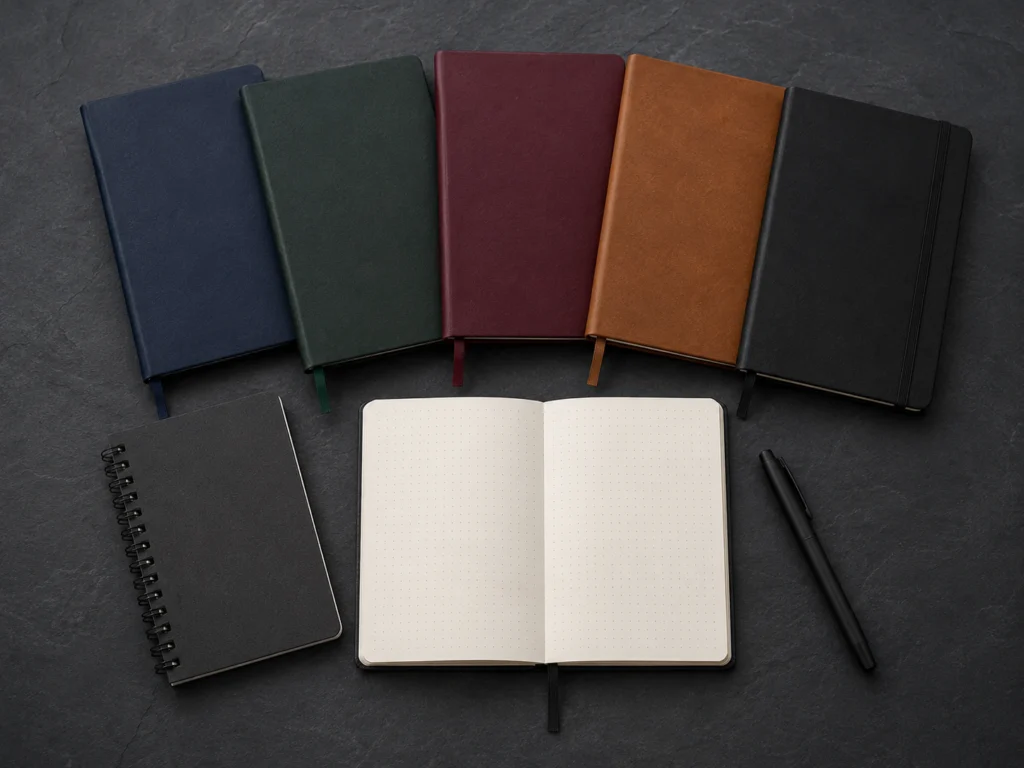
TL;DR: For most beginners, the Leuchtturm1917 A5 Hardcover (Dotted) is the right call. It has numbered pages, a built-in table of contents, and 251 pages of 80gsm FSC-certified paper that handles gel pens cleanly. If you want something simpler and cheaper, the Moleskine Classic Large Hardcover works fine. If you hate blank pages, the Five Minute Journal removes them entirely. All prices are current as of June 2026. Always verify before purchasing.
This post contains affiliate links. If you buy something through one of them, Mindfulova earns a small commission at no extra cost to you. We only recommend products we’ve researched and would use ourselves.
Most people spend too long choosing a journal and not long enough actually using one. This article is designed to shorten that decision.
We’ve written in all six journals on this list, testing each across paper quality, pen compatibility, layout comfort, and how they hold up after weeks of daily use. The rankings reflect what we actually found, not what the product descriptions say.
No journal on this list requires a learning curve. All of them are available on Amazon. None of them will make you a better writer, but a few of them will make you more likely to pick up the habit and keep it.
Before choosing a journal, it helps to know what kind of journaling you want to do. For a breakdown of journaling formats and how to build the habit, see How to Start Journaling: A No-Pressure Guide for Complete Beginners.
- What Makes a Good Beginner Journal
- The Six Best Journals for Beginners
- 1. Leuchtturm1917 Medium A5 Hardcover — Best Overall
- 2. Moleskine Classic Large Hardcover — Best Budget Pick
- 3. Five Minute Journal by Intelligent Change — Best for Beginners Who Freeze Up
- 4. Paperblanks Hardcover Midi Journal — Best for People Who Care About Aesthetics
- 5. Leuchtturm1917 120g Special Edition — Best for Fountain Pen Users
- 6. Decomposition Book — Best Eco-Friendly Budget Option
- Side-by-Side Comparison
- Which Journal Should You Actually Buy
- What About Pen Choice
- FAQ
- Keep Reading
What Makes a Good Beginner Journal
Brand name, aesthetic, color: those are the criteria most people focus on, and they matter less than three functional things:
Paper weight.
Anything below 70gsm will bleed through with a gel pen, which is annoying enough to break the habit.
80gsm is the practical minimum for comfortable everyday writing. Some journals go higher (100gsm or 120gsm), which opens up fountain pen use, but costs more.
Page count and size.
An A5 journal (roughly 5.75″ x 8.25″) gives you enough space to write without feeling like you’re filling a form. It fits in most bags.
The standard for a hardcover beginner journal in this size runs 192–251 pages, which is roughly 6–8 months of daily entries at a paragraph or two per day.
Layout.
Dotted, lined, blank, or grid. Dotted is the most versatile: the dots are subtle enough to keep your lines straight without printing grids across the page, and unobtrusive enough for sketching.
Lined is the most immediately intuitive. Blank is best avoided by beginners because it adds one more point of friction to an already unfamiliar habit.
Price matters too, but less than you might expect. The difference between a $12 notebook and a $25 journal is not the difference between succeeding and failing.
The difference is features: numbered pages, a table of contents, paper quality. If those matter to you, they’re worth the premium.
The Six Best Journals for Beginners
1. Leuchtturm1917 Medium A5 Hardcover — Best Overall
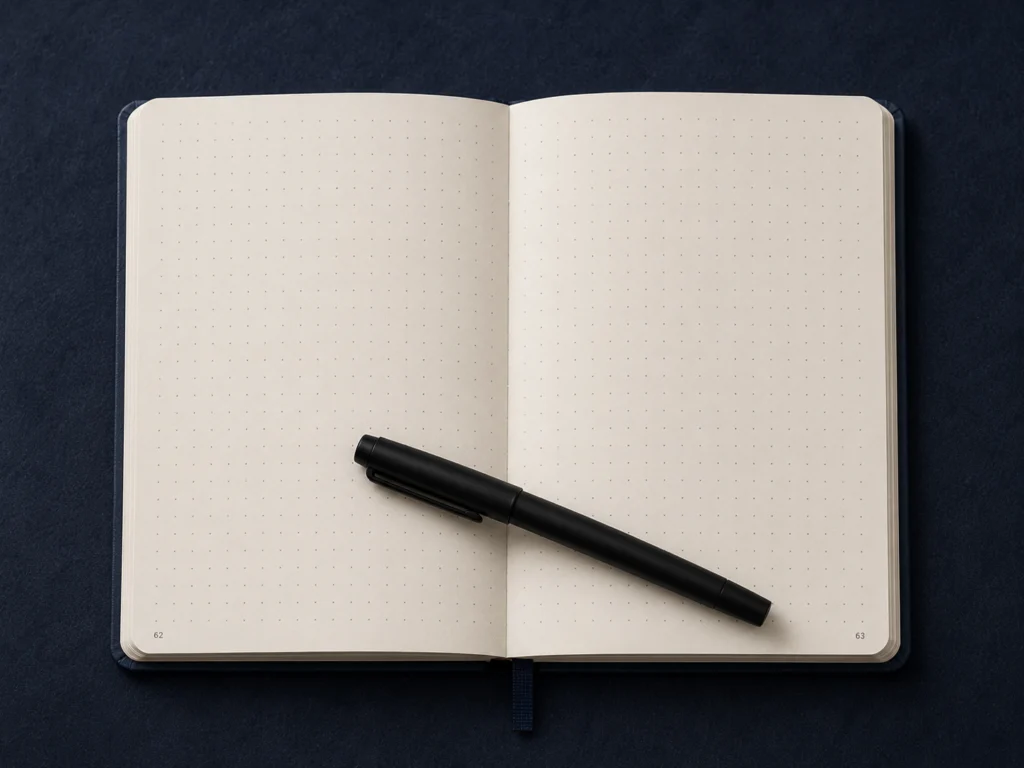
Price: ~$23–$26 on Amazon Paper: 80gsm FSC-certified, slightly chamois-tinted Pages: 251 numbered Layouts: Dotted, ruled, squared, blank Size: 5.75″ x 8.25″ (A5)
The Leuchtturm1917 A5 Hardcover comes with numbered pages, a blank table of contents, two ribbon page markers, a gusseted back pocket, an elastic closure band, and eight perforated detachable sheets.
The thread-bound spine lets it open flat, which matters when you’re writing on the left-hand page.
The dotted version is the most popular for a reason. The dots are spaced 5mm apart and printed lightly enough that they don’t compete with your writing.
They give you enough structure to write in straight lines without making every page feel like a form.
The 80gsm paper handles ballpoint and gel pens cleanly. With fine-tipped felt pens, there’s minimal ghosting: you can see faint outlines on the reverse side but it doesn’t bleed through.
For fountain pen users: medium-to-dry nibs work, wet nibs may show through.
In our testing, the Muji 0.5mm and Pilot G2 both wrote cleanly with no bleed-through. The Uni-ball Signo 0.38mm left no ghosting at all.
The faintest outlines appeared only with a Pilot G2 on densely written pages. For everyday journaling with a gel pen, the paper holds up without any issues.
The numbered pages and table of contents are the features that most differentiate this journal from cheaper alternatives.
Once you’ve been journaling for two months, being able to find an entry from three weeks ago matters. The Leuchtturm makes that possible. A Moleskine doesn’t.
What it’s not good for: Fountain pen users who want zero ghosting. The 80gsm paper is solid but not premium. The Leuchtturm 120g Special Edition ($30–$35) addresses this if it’s a priority.
Our top pick for most beginners. The Leuchtturm1917 A5 Dotted is the journal we’d tell most people to start with. Available in over 20 colors. Check current price on Amazon
2. Moleskine Classic Large Hardcover — Best Budget Pick
Price: ~$15–$22 on Amazon Paper: 70gsm FSC-certified, ivory-tinted, acid-free Pages: 240 (dotted) or 192 (ruled/plain/squared) Layouts: Ruled, dotted, squared, plain Size: 5″ x 8.25″ (close to A5)
The Moleskine Classic Large Hardcover has rounded corners, ivory-colored pages, an elastic closure, a ribbon bookmark, and an expandable inner pocket. Paper weight is 70gsm, FSC-certified, and acid-free.
The Moleskine is the more minimal option. No numbered pages, no table of contents.
The cover is slightly more flexible than the Leuchtturm. It has a cardboard-bound structure rather than a full rigid hardcover, which some people prefer for writing in their lap. The ivory paper has a warmer tone than the Leuchtturm’s chamois.
At 70gsm, the paper is lighter than the Leuchtturm. Most ballpoint pens write fine.
Gel pens (Pilot G2, Muji 0.5mm) show more ghosting than on the Leuchtturm. Fountain pens are a bad match unless you use a very dry nib.
The dotted version gives you 240 pages, which is slightly more than the Leuchtturm. The ruled version gives you 192.
That inconsistency across layouts is a minor annoyance, so check before you buy.
Who this is for: People who want a clean, simple notebook at a lower price point and don’t care about finding entries later.
Skip it if you use gel pens heavily or want to index your entries.
3. Five Minute Journal by Intelligent Change — Best for Beginners Who Freeze Up
Price: ~$28–$35 on Amazon Paper: Recycled paper, natural linen hardcover Pages: Enough for 6 months of daily use (morning + evening) Layout: Structured guided prompts (not a blank notebook) Size: Approximately A5
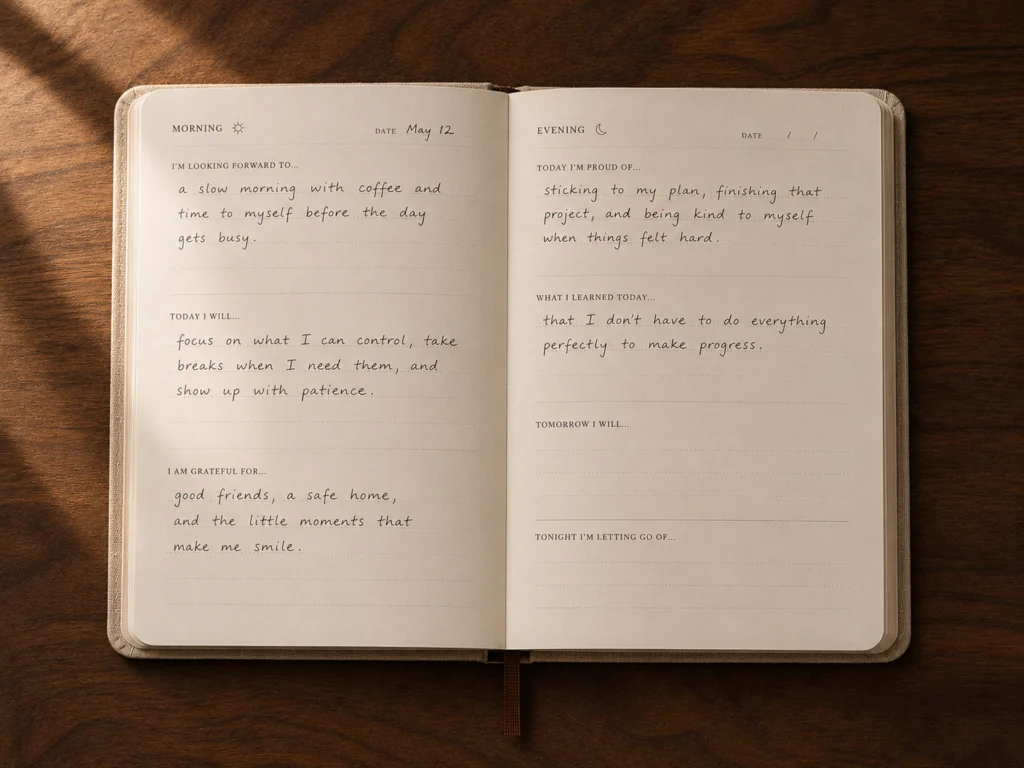
The Five Minute Journal uses a structured daily format: each morning, you write three things you’re grateful for, set one intention, and write one affirmation.
Each evening, you list three highlights and one reflection. The whole process takes roughly five minutes.
The Five Minute Journal is grounded in positive psychology research.
Emmons and McCullough’s 2003 study in the Journal of Personality and Social Psychology found that participants who wrote weekly gratitude lists exercised more, reported fewer physical symptoms, and felt more optimistic about the week ahead compared to those who recorded neutral events.
A 2020 systematic review by Boggiss et al. in the Journal of Psychosomatic Research confirmed that structured gratitude interventions produce consistent benefits for overall wellbeing and stress.
The journal’s prompt system is designed around exactly this mechanism.
This journal removes the blank page entirely. If you have tried journaling before and always stalled at “I don’t know what to write,” this is the most direct fix.
The prompts are specific enough to answer quickly but open enough to generate real reflection.
The undated format means you can’t fall behind. If you skip a Tuesday, Wednesday’s entry starts fresh with no guilt about the gap.
You start when you’re ready and skip days without losing your place.
What it’s not good for: Free-form journaling, longer reflective writing, or people who already know what they want to write about.
The structure that helps beginners feels constraining to experienced journalers.
Note on price: The Five Minute Journal is not cheap for what you get physically. You’re paying for the framework and the brand, not the paper quality.
If budget is a constraint, buying a $10 notebook and writing your own morning/evening prompts in the inside cover gets you 80% of the same result.
4. Paperblanks Hardcover Midi Journal — Best for People Who Care About Aesthetics
Price: ~$17–$25 on Amazon or Barnes & Noble Paper: Fine laid writing paper, acid-free, archival quality. Paperblanks offers 85gsm, 100gsm, and 120gsm depending on the specific edition. Check the individual product page before purchasing. Pages: Varies by edition (~144 lined) Layout: Lined or unlined Size: Midi (approx. 5″ x 7″)
Paperblanks journals are bound using either hand-stitching (Coptic binding, originating in 4th century Egypt) or Smythe sewing, the most durable binding technique, which allows the journal to open flat without page loss.
All Paperblanks use fine laid writing paper that is acid-free, archival quality, and high opacity.
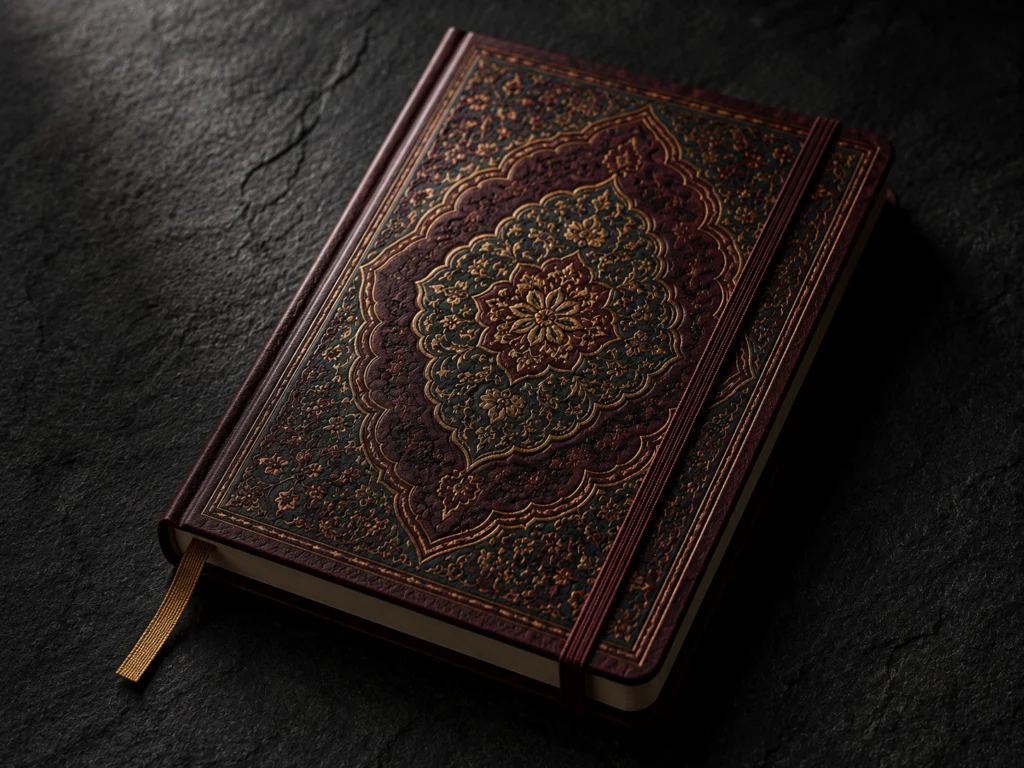
Paperblanks is the most visually distinctive journal on this list. The covers are detailed reproductions of historical manuscripts, embossed art, and archival designs.
If a journal’s appearance affects whether you’ll pick it up, Paperblanks is worth the extra few dollars.
The paper quality is legitimately good. Acid-free and archival construction means it won’t yellow over time, which matters if you plan to keep journals long-term.
Paper weight varies by edition: Paperblanks Midi journals run between 85gsm and 120gsm depending on which series you buy. The 120gsm editions handle gel pens and most ballpoint pens cleanly with minimal ghosting.
The 85gsm editions perform closer to Moleskine’s 70gsm: fine for ballpoint, less ideal for gel pens. Check the product page before buying if paper weight matters to you.
The Midi size is slightly smaller than A5, which some people find more portable. It’s also slightly less writing space per page.
For most beginners this won’t matter, but if you write large or need more room for longer entries, check the Ultra size instead.
What it’s not good for: Numbered pages and indexing. Paperblanks doesn’t offer this.
Also not ideal for people who want to start writing immediately without thinking about their notebook choice, because the wide range of cover designs can become its own decision paralysis.
If the journal’s appearance matters to you: Paperblanks are the best-looking beginner journals at this price range. The cover designs are based on historical manuscripts and art, genuinely different from anything Leuchtturm or Moleskine offers. Browse current Paperblanks selection on Amazon
5. Leuchtturm1917 120g Special Edition — Best for Fountain Pen Users
Price: ~$30–$38 on Amazon Paper: 120gsm FSC-certified Pages: 203 numbered Layout: Dotted or ruled Size: A5
This is the same notebook as the standard Leuchtturm1917 with one significant difference: the paper is 120gsm instead of 80gsm.
The 120G Special Edition has 203 numbered pages with 120gsm paper, which handles fountain pen ink with minimal feathering or bleed-through.
For beginners using ballpoint or gel pens, the standard 80gsm Leuchtturm is adequate and $8–$12 cheaper. The 120g edition makes sense if you already use a fountain pen and the ghosting on standard paper bothers you.
The trade-off is page count. At 120gsm, you get 203 pages instead of 251, roughly 48 fewer pages for the higher price. For everyday journaling that’s still 5–6 months of daily use.
Who this is for: Beginners who already own a fountain pen and know they’ll use it. Not a priority purchase for everyone else.
6. Decomposition Book — Best Eco-Friendly Budget Option
Price: ~$10–$14 on Amazon Paper: 100% post-consumer-waste recycled paper, 70gsm equivalent Pages: 160 Layout: Ruled or graph Size: 7.5″ x 9.75″ (larger than A5)
The Decomposition Book is the most sustainable option on this list and the cheapest.
Made entirely from recycled materials, with printed covers featuring nature illustrations, it’s a straightforward spiral-bound notebook that does the job without ceremony.
The paper is adequate for ballpoint and pencil. Gel pens work with some ghosting on darker pages due to the recycled paper’s natural variation. Fountain pens are not ideal.
The spiral binding is its main drawback for journaling: it doesn’t close securely, and the coil catches on things in a bag.
For desk-based journaling, this is a non-issue. For writers who carry their journal everywhere, it’s worth considering.
Note that at 7.5″ x 9.75″, this is noticeably larger than A5, closer to a standard letter-size notebook.
If size parity with the other journals on this list matters, factor that in before buying.
Who this is for: People on a tight budget, people who prioritize sustainability, or people who want to test whether journaling sticks before spending $25 on a Leuchtturm.
Side-by-Side Comparison
| Journal | Price | Paper | Pages | Indexed | Best For |
|---|---|---|---|---|---|
| Leuchtturm1917 A5 | ~$23–$26 | 80gsm | 251 | Yes | Most beginners |
| Moleskine Classic Large | ~$15–$22 | 70gsm | 192–240 | No | Budget + minimal |
| Five Minute Journal | ~$28–$35 | Recycled | ~180 | No | Blank-page avoiders |
| Paperblanks Midi | ~$17–$25 | 85–120gsm | ~144 | No | Aesthetics-first |
| Leuchtturm1917 120g | ~$30–$38 | 120gsm | 203 | Yes | Fountain pen users |
| Decomposition Book | ~$10–$14 | 70gsm recycled | 160 | No | Eco-budget |
Prices verified June 2026. Always confirm current pricing on Amazon before purchasing.
Which Journal Should You Actually Buy
Buy the Leuchtturm1917 A5 Dotted if you want the most complete beginner journal and don’t mind paying $23–$26.
The numbered pages and table of contents sound like minor features until you’re two months in and want to find something you wrote three weeks ago. The Leuchtturm makes that easy. The Moleskine doesn’t.
Buy the Moleskine Classic Large if you want to spend less and don’t need to index your entries.
It’s a solid notebook. The paper is lighter than the Leuchtturm and gel pens will show more ghosting, but it’s not bad enough to stop you.
Buy the Five Minute Journal if you’ve tried and abandoned journaling before, specifically because you never knew what to write.
The structured prompts solve that problem directly. If you already know what you want to write about, save the money and get a Leuchtturm.
Buy the Decomposition Book if budget is genuinely the constraint. At $10–$14, you can test the habit for three months without committing much money. If journaling sticks, upgrade to a Leuchtturm then.
What About Pen Choice
The journal you write in matters less than the pen you write with. A scratchy, skipping pen makes any notebook unpleasant.
The standard recommendation for any of the journals above:
Muji Gel Ink Ballpoint 0.5mm. Writes cleanly on all 80gsm+ paper, minimal ghosting, $2–$3 each. Pilot G2 0.5mm. Slightly more ink flow, widely available, works well on Leuchtturm and Paperblanks paper. Uni-ball Signo 0.38mm. The finest line of the three. Good if you write small.
Avoid felt-tip pens on anything below 80gsm. Avoid wet-nib fountain pens on Moleskine.
For a deeper look at building the actual habit (how often to write, how to handle the blank page, and what to do when you miss days), see How to Start Journaling: A No-Pressure Guide for Complete Beginners.
Ready to start? The Leuchtturm1917 A5 Dotted is our top recommendation. Pair it with a Muji 0.5mm gel pen and you have everything you need. Check current price on Amazon
FAQ
It depends on what “worth it” means to you. A $25 Leuchtturm has features (numbered pages, table of contents, better paper) that a $10 notebook doesn’t. Those features genuinely help if you plan to journal long-term and want to refer back to entries. If you’re testing whether journaling sticks at all, start cheap and upgrade once it does.
For most beginners, the Leuchtturm1917. The numbered pages and table of contents are genuinely useful once you’re a few months in and want to find something you wrote in week three. The 80gsm paper handles gel pens with less ghosting than Moleskine’s 70gsm. Both are thread-bound and open flat.
That said, the Moleskine makes more sense in three specific situations: you already own one and don’t want to buy new; you write with a wetter fountain pen and want thicker paper without paying for the Leuchtturm 120g; or you simply prefer a minimal notebook with no index system to maintain. The Moleskine’s cover is also slightly more flexible, which some people prefer for writing in their lap.
Price difference is roughly $3–$6 depending on color and where you buy. For most people starting fresh, that gap is worth it for the Leuchtturm. For people who know they won’t use an index, it isn’t.
A5 (roughly 5.75″ x 8.25″) is the standard recommendation and the most widely available. It gives you enough space to write comfortably without requiring a desk. Pocket-sized journals (A6) are better for people who want to carry their journal everywhere and write short entries. A4 is typically too large for daily journaling unless you also sketch.
Dotted is the most versatile for beginners. It provides enough structure to write in straight lines without printing lines across the page. Lined paper is the most immediately intuitive: just write. Blank paper requires the most confidence because there’s no structure at all. Most beginners find dotted or lined more comfortable than blank. Grid (squared) paper is best for people who also want to sketch or do layouts.
For everyday journaling at a paragraph or two per day, 200–250 pages lasts roughly 6–8 months. That’s a good starting point. Shorter journals (160 pages, like the Decomposition Book) work if you write less frequently. The important thing is to finish a journal before buying another one. Completing a journal is its own satisfying milestone.
Yes. A $2 composition notebook from a drugstore works. The functional difference between that and a $25 Leuchtturm is paper quality, organization features, and durability. None of those differences determine whether journaling works for you. They determine whether the experience is pleasant after it’s already working. Start with what you have if you’re uncertain.
Keep Reading
- How to Start Journaling: A No-Pressure Guide for Complete Beginners
- 50 Journal Prompts for When You Have Nothing to Write About
- Morning Journaling vs. Evening Journaling: Which One Is Right for You?
- What Are Analog Hobbies? A Starter List for People Tired of Screens

We research screen-free habits, analog hobbies, and offline routines so you can spend less time scrolling and more time doing things that actually feel good. Every article on this site is based on primary research and verified sources, not recycled wellness advice.
Learn more on our About page.
All product specifications verified from manufacturer websites and Amazon listings as of June 2026. Prices are subject to change. Verify current pricing on Amazon before purchasing.
Sources:
- Emmons, R.A. & McCullough, M.E. (2003). Counting blessings versus burdens: An experimental investigation of gratitude and subjective well-being in daily life. Journal of Personality and Social Psychology, 84(2), 377–389.
- Boggiss, A.L. et al. (2020). A systematic review of gratitude interventions: Effects on physical health and health behaviors. Journal of Psychosomatic Research, 135, 110165.
- Paperblanks product specifications: paperblanks.com (accessed June 2026).
- Leuchtturm1917 product specifications: leuchtturm1917.us (accessed June 2026).
- Moleskine product specifications: Amazon listings (accessed June 2026).
- Decomposition Book product specifications: Amazon listings (accessed June 2026).