

TL;DR: Morning journaling is better for clarity, intention-setting, and creative work. Evening journaling is better for processing the day, emotional release, and sleep. Neither is objectively superior. What matters most is consistency, and the best time is whichever one you’ll actually stick to. If you’re undecided, try morning for two weeks first: the research on habit formation suggests morning behaviors tend to become automatic faster than evening ones.
This question comes up constantly for people starting a journaling habit. It feels like there should be a definitive answer, a time that’s objectively better, backed by science, that you can slot into your routine and be done with it.
There isn’t. But the two options aren’t equivalent either. Morning journaling and evening journaling produce different results through different mechanisms, and understanding that difference makes choosing between them much simpler.
This article covers what each timing actually does, what the research says, and how to make the decision based on what you’re trying to get out of journaling.
For guidance on building the habit itself before you decide on timing, see How to Start Journaling: A No-Pressure Guide for Complete Beginners.
What Morning Journaling Actually Does
Morning journaling works on the principle of catching your mind before the day’s noise takes over.
When you write first thing (before checking your phone, before the first meeting, before any external demand lands) you’re writing from a relatively uncontaminated mental state.
There are two mechanisms worth understanding here.
The cortisol awakening response.
In the first 30–45 minutes after waking, cortisol levels in the body are at or near their daily peak.
Though whether this peak is triggered by the act of waking itself or simply reflects the body’s circadian rhythm is still debated in recent research, the practical outcome is consistent: cortisol is substantially higher in the morning than in the evening, and this elevated level primes alertness, supports memory consolidation, and increases motivation.
Writing during this window means you’re engaging your cognition at a neurologically activated moment, before the day’s stimuli start competing for attention.
Cognitive offloading before external demands arrive.
Research on expressive writing consistently shows that externalizing thoughts, putting them on paper, reduces cognitive load.
In the morning, this means clearing the mental residue of sleep and the previous day before the new day’s demands accumulate on top of it.
The result is a cleaner starting point for decision-making and focus.
Five to ten minutes of morning journaling processes the residual cognitive and emotional content of sleep and the previous day before the new day’s demands arrive.
This is the practical payoff: you’re not carrying yesterday’s unresolved thoughts into today’s work.
Morning Pages — the structured version
The most well-known morning journaling format is Morning Pages, introduced by Julia Cameron in The Artist’s Way (1992).
The method is specific: three handwritten pages of stream-of-consciousness writing, completed first thing in the morning, before any other activity.
Julia Cameron’s original prescription is specific for a reason. Each rule serves a particular psychological purpose, from disarming the inner critic to accessing pre-rational creative states.
The benefits compound over weeks, not days, with most practitioners needing 8 to 12 weeks of daily practice before the deeper creative and emotional shifts become tangible.
Morning Pages aren’t journaling in the traditional sense. You’re not writing for posterity or self-discovery. You’re clearing mental static so the rest of your day isn’t dragging it around.
The three-page format is long enough to get past surface-level thoughts and short enough to complete in 20–30 minutes.
Morning Pages are particularly well-suited for people doing creative work (writing, design, strategy) because they tend to surface ideas and remove internal resistance before the work begins.
They’re less suited for people whose mornings are genuinely constrained, because the format doesn’t compress well below three pages without losing its effect.
When morning journaling works best
- You want to set a clear intention before the day starts
- You do creative or strategic work that benefits from a clear head
- Your evenings are inconsistent (kids, social commitments, variable energy)
- You want to build the habit faster: research published in Health Psychology (Fournier et al., 2017) found that behaviors practiced in the morning reach automaticity significantly faster than the same behaviors practiced in the evening, with the morning group achieving automaticity at 106 days compared to 154 days for the evening group
When morning journaling doesn’t work well
- You have genuinely no time before work obligations begin
- You’re not a morning person. Chronic evening types (late chronotypes) have lower cortisol peaks in the morning, which reduces the neurological advantage
- What you want from journaling is primarily to process the day. You can’t reflect on events that haven’t happened yet
What Evening Journaling Actually Does
Evening journaling operates on a different principle: you have material to work with. The day has happened. You have experiences, conversations, frustrations, and small wins to process.
Evening journaling is inherently more retrospective. Its primary function is making sense of what occurred, not preparing for what’s coming.
This retrospective quality produces two outcomes that morning journaling doesn’t reliably generate.
Emotional processing and closure.
Events that happen during the day (a difficult email, a conversation that didn’t go well, a decision you’re second-guessing) stay in working memory until they’re processed.
Writing about them externalizes the material and helps form what researchers call a “coherent narrative” around the experience.
Scullin et al. (2018), published in the Journal of Experimental Psychology: General, found that writing at bedtime, specifically writing a to-do list for upcoming days, helped participants fall asleep an average of 9 minutes faster compared to those who wrote about completed tasks.
The mechanism: writing offloads unfinished mental business, reducing the cognitive cycling that delays sleep onset.
Pattern recognition over time.
Because evening entries document what actually happened rather than intentions, they create a more accurate record of your life.
Reviewing a month of evening entries shows you what you actually spent your time on, how you actually felt, and what patterns recur.
Morning entries show you what you hoped would happen. Evening entries show you what did.
What the sleep research actually says
The Baylor University study deserves a closer look because it’s often misrepresented.
Scullin et al. (2018) compared sleep patterns of participants who took five minutes to write down upcoming duties versus participants who chronicled completed activities, using polysomnography (the gold standard of sleep measurement).
The to-do list group fell asleep an average of 9 minutes faster. In sleep medicine, 9 minutes is a clinically meaningful difference, comparable to the effect size seen with some behavioral sleep interventions.
The important qualifier: the benefit came from writing a forward-looking to-do list, not from writing about the day. Writing about completed tasks produced slower sleep onset than writing about future ones.
The mechanism appears to be cognitive offloading: by writing down what needs to happen tomorrow, the brain releases the need to keep cycling through it.
This has a practical implication for evening journalers: ending your session with a brief list of the next day’s priorities is more sleep-conducive than ending with an open-ended reflection.
The reflection is still valuable. Do it first. Then close with the list.
When evening journaling works best
- Sleep is a specific goal. The Scullin data supports this directly
- You want to process the day before it compresses into vague memory
- Your mornings are genuinely impossible to modify
- You’re an evening person whose cognitive energy peaks later in the day
- You want an accurate record of your life, not just your intentions
When evening journaling doesn’t work well
- Your evenings are variable. Social commitments, family demands, and energy crashes make consistency harder
- You tend toward rumination: reviewing a difficult day without structure can amplify negative feelings rather than process them. If this is you, use a structured prompt from the emotional processing category rather than free-form writing. For specific prompts organized by situation, see 50 Journal Prompts for When You Have Nothing to Write About
- You want to use journaling to set daily direction. Evening journaling can do this, but it’s less direct than morning
The Direct Comparison
| Morning Journaling | Evening Journaling | |
|---|---|---|
| Primary function | Clarity, intention, creative priming | Processing, reflection, emotional closure |
| Best for sleep | Not specifically | Yes – Scullin (2018) supports evening to-do lists |
| Habit formation speed | Faster (cortisol peak advantage) | Slower – more competing demands |
| Material to work with | Yesterday’s residue + today’s blank canvas | The day’s actual events |
| Risk | Shallow entries if you haven’t had time to live anything | Rumination without structure |
| Ideal session length | 5–20 minutes | 10–20 minutes |
| Morning pages compatible | Yes – this is the native format | No – three pages of morning pages in the evening loses its effect |
How to Actually Decide
Start with your constraint, not your preference.
Most people who ask “morning or evening?” are really asking “which one is easier to maintain?”
That’s the right question. The best journaling practice is the one you’ll actually do three weeks from now, not the one that sounds optimal in theory.
If your mornings are fixed (work starts at 7, kids need to be fed, you’re not a morning person), evening is the practical choice.
If your evenings are unpredictable (dinner runs long, social plans come up, you crash at 9pm), morning is the practical choice.
If you’re genuinely undecided, start with morning.
Two reasons. First, the habit formation research suggests morning behaviors reach automaticity faster.
Second, morning journaling requires less willpower: there are fewer competing demands before 8am than after 8pm for most people. Fewer decisions means fewer points of failure.
At Mindfulova, we’ve found this holds in practice. Evening sessions are easier to skip: a dinner runs long, energy drops, the notebook stays closed.
Morning sessions, once anchored to an existing routine like coffee or brushing teeth, tend to stick within two to three weeks.
If you try morning and it genuinely doesn’t work after two weeks, switch. But most people who think they’re not morning people find that five minutes of writing is a much lower bar than a full morning routine.
The two-week test.
Pick one timing. Commit to it for two weeks without switching. Write for a minimum of five minutes.
At the end of two weeks, ask: Did I do it? Did it feel sustainable? Did it produce anything useful?
If the answer to all three is yes, continue. If the consistency was difficult, switch to the other timing and repeat the test.
Most people know within 10–14 days whether a habit slot is going to hold.
Both is an option, but start with one.
Running morning and evening sessions simultaneously before either is established tends to produce inconsistency in both.
Morning Pages practitioners specifically warn against doing a condensed version in the evening.
The format loses its function when removed from its timing. Build one habit first. If it holds for 60 days, add the other.
What Journal to Use for Each Timing
Both morning and evening journaling work best with a dedicated physical journal.
Picking up the same notebook at the same time each day functions as a habit cue: it signals the brain that a specific activity is beginning, which is part of how behavioral routines become automatic.
For a full breakdown of which journals hold up best for daily use, see Best Journals for Beginners: Tested and Ranked.
For free-form morning or evening journaling: The Leuchtturm1917 A5 Dotted is 251 numbered pages of 80gsm paper with a built-in table of contents. Good for both morning and evening use, and durable enough for daily handling. Check current price on Amazon
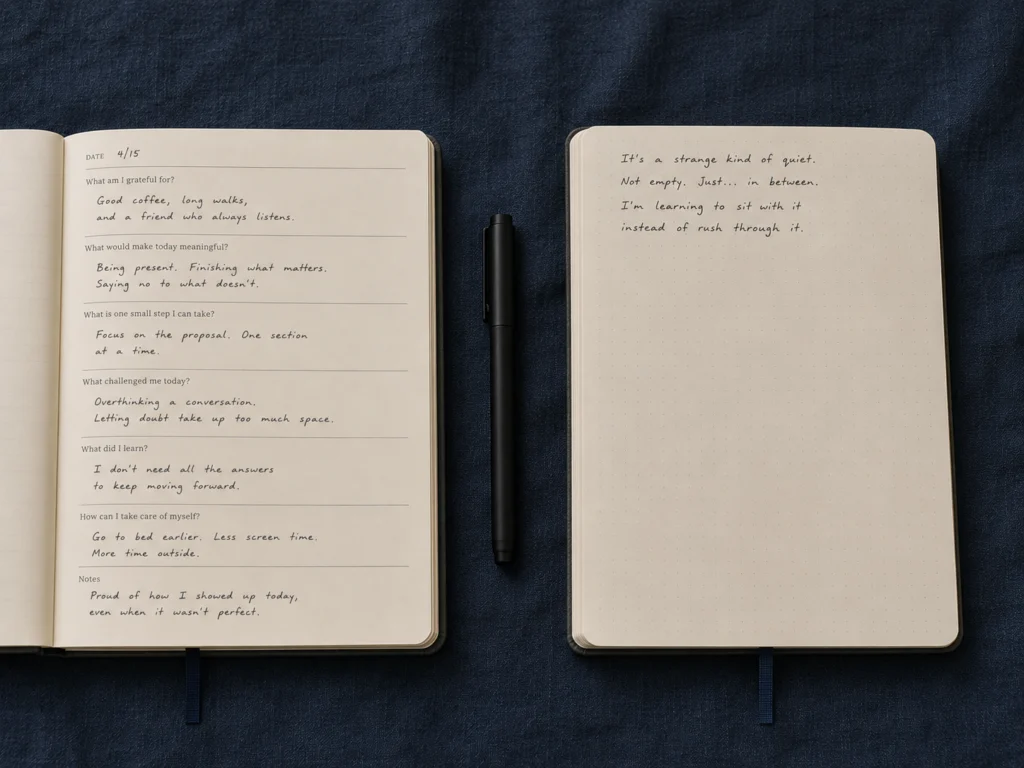
For structured morning + evening sessions: The Five Minute Journal has dedicated morning and evening prompt sections built in. Each takes roughly two to three minutes. Undated, so you can’t fall behind. Check current price on Amazon
FAQ
Not in the sense of a direct head-to-head study comparing morning versus evening journaling outcomes. What exists is research on the mechanisms: the cortisol awakening response supports habit formation in the morning, and Scullin et al. (2018) found specific sleep benefits from bedtime writing. Neither study makes a global claim that one timing is better. Each produces specific advantages for specific goals.
Five minutes is enough for both formats. For morning journaling, five minutes of focused free-writing or three specific intentions produces real value. For evening journaling, five minutes of reflection plus a brief to-do list for tomorrow covers the two mechanisms the research supports most. Don’t skip because you can’t do 20 minutes.
You can, but it makes habit formation slower. The automaticity of a journaling habit depends partly on consistent timing. The same time each day functions as a reliable cue. If you vary the timing based on how the day goes, the cue is weaker and the habit takes longer to stick. Once the habit is established (roughly 60+ days), timing flexibility is less disruptive.
It matters somewhat. The research on expressive writing, Pennebaker’s work in particular, shows that writing combining thoughts and emotions produces better outcomes than purely descriptive or purely emotional writing. This applies regardless of timing. For specific prompts organized by situation and mood, see 50 Journal Prompts for When You Have Nothing to Write About.
This happens. Evening journaling without structure can become rumination, replaying events rather than processing them. If this is your experience, two adjustments help: use a specific prompt from the emotional processing category (which pushes toward resolution rather than replay), and always end your session with a forward-looking to-do list for tomorrow. The Scullin research shows this specific close reduces cognitive cycling, which is what creates pre-sleep anxiety. If evening journaling consistently increases anxiety rather than reducing it, switch to morning.
No. Morning Pages is a specific format: three handwritten pages of stream-of-consciousness writing, done first thing, before any other activity, with no editing or stopping. Standard morning journaling is more flexible in length, content, and format. Morning Pages is one version of morning journaling, but the reverse isn’t true. If you’re new to journaling, standard morning journaling (5–10 minutes, any content) is a better starting point than the full Morning Pages format, which requires more time and is harder to sustain in the early weeks.
Keep Reading
- How to Start Journaling: A No-Pressure Guide for Complete Beginners
- 50 Journal Prompts for When You Have Nothing to Write About
- Best Journals for Beginners: Tested and Ranked
- What Are Analog Hobbies? A Starter List for People Tired of Screens

We research screen-free habits, analog hobbies, and offline routines so you can spend less time scrolling and more time doing things that actually feel good. Every article on this site is based on primary research and verified sources, not recycled wellness advice.
Learn more on our About page.
Sources referenced in this article:
- Scullin, M.K., Krueger, M.L., Ballard, H.K., Pruett, N., & Bliwise, D.L. (2018). The effects of bedtime writing on difficulty falling asleep: A polysomnographic study comparing to-do lists and completed activity lists. Journal of Experimental Psychology: General, 147(1), 139–146. https://doi.org/10.1037/xge0000374
- Fournier, M., d’Arripe-Longueville, F., Rovère, C., Easthope, C.S., Schwabe, L., El Methni, J., & Radel, R. (2017). Effects of circadian cortisol on the development of a health habit. Health Psychology, 36(11), 1059–1064. https://doi.org/10.1037/hea0000510
- Cameron, J. (1992). The Artist’s Way. Jeremy P. Tarcher/Perigee.
- Pennebaker, J.W. & Beall, S.K. (1986). Confronting a traumatic event: Toward an understanding of inhibition and disease. Journal of Abnormal Psychology, 95, 274–281.
- Lieberman, M.D. et al. (2007). Putting feelings into words: Affect labeling disrupts amygdala activity in response to affective stimuli. Psychological Science, 18(5), 421–428.
- Lally, P. et al. (2010). How are habits formed: Modelling habit formation in the real world. European Journal of Social Psychology, 40(6), 998–1009.