

TL;DR: The blank page is the most common reason people quit journaling. This list gives you 50 prompts organized into seven categories (daily check-ins, emotional processing, clarity and decisions, relationships, growth, gratitude, and big-picture questions) so you always have a starting point. Copy your five favorites into your journal’s inside cover and return to this page whenever you run dry.
This post contains affiliate links. If you buy something through one of them, Mindfulova earns a small commission at no extra cost to you.
The blank page is a genuine obstacle. Not a character flaw, not a sign that journaling isn’t for you. Just a design problem.
Most people sit down to journal without any idea what they want to write, and when nothing comes, they close the notebook and walk away.
Prompts solve this. A specific question is easier to answer than an open invitation to reflect. You don’t need to feel inspired. You need a place to start.
The 50 prompts below are organized into seven categories. They’re based on the kinds of questions used in expressive writing research, specifically the framework developed by James Pennebaker at the University of Texas, whose work since 1986 has linked structured reflective writing to measurable improvements in mental and physical health.
Subsequent research published in Frontiers in Psychology (Lau & Tov, 2023) confirmed that different types of reflective prompts, particularly those combining emotional labeling with perspective-taking, produce the strongest outcomes for processing everyday stress.
Not every prompt will resonate on every day. That’s expected. Scan the category that matches where you are, pick one, and write.
For guidance on building the journaling habit itself (how often to write, what time of day, and how to push through the first weeks), see How to Start Journaling: A No-Pressure Guide for Complete Beginners.
- How to Use These Prompts
- Category 1: Daily Check-In (10 Prompts)
- Category 2: Emotional Processing (10 Prompts)
- Category 3: Clarity and Decisions (8 Prompts)
- Category 4: Relationships (7 Prompts)
- Category 5: Growth and Self-Awareness (8 Prompts)
- Category 6: Gratitude (5 Prompts)
- Category 7: Big Picture (7 Prompts)
- A Note on Rumination vs. Reflection
- What Journal Works Best for Prompts
- FAQ
- Keep Reading
How to Use These Prompts
The inside cover method. Pick five prompts from this list and write them inside the front cover of your journal. When you sit down and don’t know what to write, open the cover and choose one. No scrolling, no searching.
The rotation method. Number the prompts 1–50 and work through them in order over 50 sessions. Don’t skip. Even a prompt that seems unrelated to your current mood will produce something worth writing, often more than a prompt that feels obvious.
The mood-match method. On days when you’re processing something specific (stress, a difficult conversation, a decision you can’t land on), go directly to the relevant category. These prompts are designed to move you through it rather than around it.
One important note: these prompts are most effective when you write past the first obvious answer. If a prompt asks “What am I avoiding?” and you write a sentence, keep going. The second or third paragraph is usually where the actual answer is.

Category 1: Daily Check-In (10 Prompts)
These are low-stakes entry points. Use them when you don’t want to go deep, when you just need to break the seal and get words on the page. They work well as evening entries after ordinary days.
- What’s actually on my mind right now, before I start editing it?
- Rate today from 1–10 and write two sentences explaining why.
- What’s one thing I did today that I’m glad I did?
- What’s one thing I wish had gone differently, and what would “differently” have looked like?
- Who did I talk to today? What did I take away from it, if anything?
- What did I eat, where did I go, and what did I notice that I wouldn’t normally mention?
- What’s one thing that happened today that I want to remember in a year?
- What’s sitting in the back of my mind that I haven’t dealt with yet?
- What would make tomorrow feel like a good day?
- If I had to describe today’s mood as weather, what would it be and why?
Category 2: Emotional Processing (10 Prompts)
Research published in Frontiers in Psychology (Wallace-Hadrill & Kamboj, 2016) reviewed 38 studies on perspective-taking in journaling and found that deliberately writing about yourself in the third person, as though you’re describing someone else, reduces emotional reactivity and makes difficult feelings easier to examine. Several prompts in this section use that technique.
Use these when something specific is bothering you, when you feel off but can’t identify why, or when you want to process something rather than just vent about it.
- What am I feeling right now? Name the emotion as precisely as you can. Not just “stressed” or “fine,” but the specific texture of it.
- Where does this feeling live in my body? What does it feel like physically?
- If a close friend described what I’ve been going through this week, what would they say?
- Write about what’s bothering you in the third person, using your own name. What would you tell that person if they came to you with this?
- What am I angry about that I haven’t fully acknowledged?
- What am I grieving right now? Even something small.
- What emotion have I been suppressing or pushing down? What happens if I let it be here on the page?
- Is there something I keep replaying in my mind? Write it out once, in full, and then write what you actually want to happen next.
- What’s a feeling I’ve been having that I’d be embarrassed to admit out loud?
- What does “feeling better” actually look like for me right now? Not in general. Right now, specifically.

Category 3: Clarity and Decisions (8 Prompts)
These prompts work best when you’re facing a decision, feeling stuck, or carrying a problem you haven’t resolved.
Writing through a decision is different from thinking through one. The physical act of writing slows you down and forces you to be more precise about what you actually think.
- What’s a decision I’ve been sitting on? What’s stopping me from making it?
- What would I do if I knew I couldn’t fail? (Write the actual answer, not the idealized one.)
- What do I need less of in my life right now? What’s one concrete step to get there?
- What do I need more of, and what’s one thing standing in the way?
- Write out both sides of something you’re unsure about. Then write what you’d tell a friend in the same position.
- What am I overcomplicating? What’s the simplest version of this situation?
- What’s the thing I already know I should do, but keep avoiding?
- If I look back on this decision in five years, what will I wish I had prioritized?
Category 4: Relationships (7 Prompts)
A review of expressive writing research by Baikie and Wilhelm (2005) found consistent evidence that writing about emotionally significant experiences, including difficult interpersonal situations, reduces psychological distress and improves overall wellbeing across clinical and non-clinical populations.
Private writing removes the social pressure that typically shapes what we say out loud, which is part of what makes it effective for relationship-related processing. These prompts are designed for that. You’re not sending this to anyone.
- Who has been on my mind lately, and why?
- Is there something I want to say to someone that I haven’t said? Write it here, unsent.
- Who in my life do I feel most like myself around? What does that tell me?
- Is there a relationship I’ve been neglecting? What would it take to re-engage with it?
- Write about a recent conversation that didn’t go the way I wanted. What would I change?
- Who has shown up for me lately that I haven’t fully acknowledged or thanked?
- Is there a relationship that’s been draining me? What’s one honest thing I can say about it on this page?
Category 5: Growth and Self-Awareness (8 Prompts)
These take more time to answer than the daily check-in prompts. They’re better suited for longer sessions: a weekend morning, or an evening when you have 20 minutes without interruption.
They tend to produce the entries you’ll want to read back.
- What’s something I believed five years ago that I no longer believe? What changed?
- What’s a pattern I keep repeating that I’m not proud of? What’s underneath it?
- What have I gotten better at in the last year that I haven’t acknowledged?
- What’s a version of myself I’m trying to move away from? What does that version look like?
- What’s a version of myself I’m trying to become? What does that person actually do differently?
- What’s something I’ve achieved that I’ve never fully celebrated? Take a minute and celebrate it here.
- What’s a fear that’s been shaping my decisions without me fully admitting it?
- If I described my current season of life to someone in a letter, what would I say?
Category 6: Gratitude (5 Prompts)
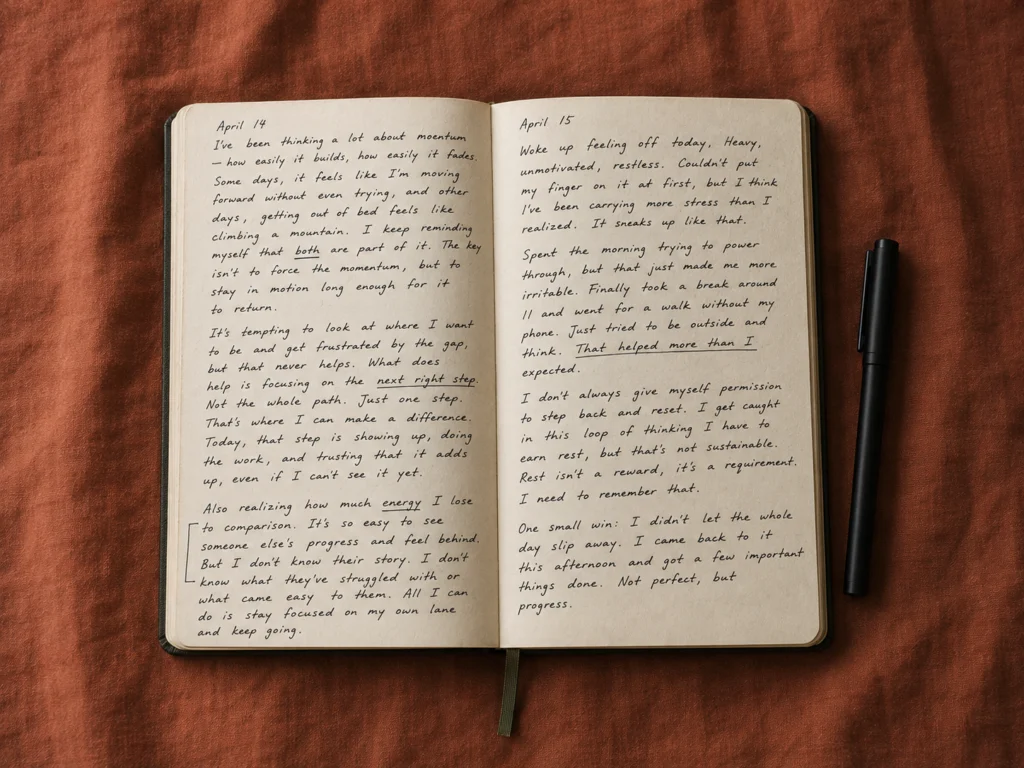
Gratitude prompts work better when they’re specific rather than broad.
Writing “I’m grateful for my health” produces less of a cognitive or emotional response than writing about one specific moment where your body did something you’re glad it could do.
Emmons and McCullough (2003), whose gratitude research forms the basis of the Five Minute Journal methodology, found that participants who wrote about specific things they were grateful for, rather than general life circumstances, reported significantly higher wellbeing and fewer physical complaints over a 10-week period.
- Write about one specific moment from the past week that you don’t want to forget.
- What’s something about your body or physical life you’re grateful for that you usually take for granted?
- Who made something easier for you recently? Write about what they did and what it meant.
- What’s something about your current circumstances that a past version of you would be relieved to know?
- What’s one small, ordinary thing from today that was actually good?
Category 7: Big Picture (7 Prompts)
Use these sparingly: once a month, or at the end of a season or year. They require more sitting with than the other categories.
Don’t rush the answer. Write what comes, not what sounds right.
- What do I want my life to look like in three years? Not in terms of achievements. In terms of what a typical Tuesday feels like.
- What would I regret not having done or said if I found out this was my last year?
Two to round out the seven:
- What’s something about who I am that I’ve never written down before?
- What matters most to me right now, and how much of my time actually goes toward it?
(Yes, that’s 52. The extras are intentional. Use whichever resonate.)
Five prompts worth copying into your inside cover right now:
- What’s actually on my mind right now, before I start editing it? (#1)
- What am I avoiding, and why? (adapted from #27)
- What would make tomorrow feel like a good day? (#9)
- Who has been on my mind lately, and why? (#29)
- What’s something about who I am that I’ve never written down before? (#51)
These five cover daily processing, avoidance, forward planning, relationships, and self-discovery. Prompt #1 is the one we come back to most. It forces you to write what’s actually there before your brain decides whether it’s worth saying.
A Note on Rumination vs. Reflection
Not all journaling is equally useful. There’s a difference between processing something and spiraling into it.
Pennebaker’s protocol emphasizes combining thoughts and emotions. Writing “I’m angry at my boss” is surface-level, but expressive writing pushes deeper: connecting the feeling to a pattern, a belief, or a need.
The goal is movement, not repetition. If you find yourself writing the same thing session after session without anything shifting, that’s a signal to change the prompt category or try the third-person technique from Category 2.
Journaling complements professional support; it doesn’t replace it. If you’re working through something serious, write, but also talk to someone qualified to help.
What Journal Works Best for Prompts
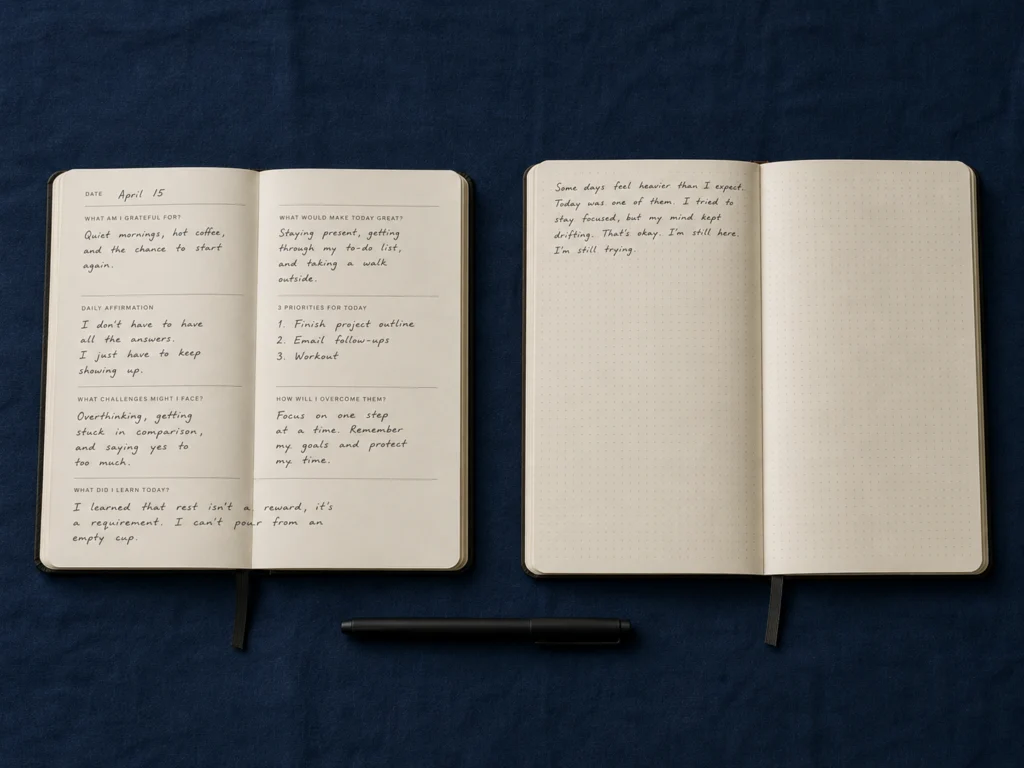
For prompt-based journaling, two options stand out. If you want to write freely in response to prompts, any journal with clean paper works.
The Leuchtturm1917 A5 Dotted is the most functional choice for everyday use. If you want the prompts built in and the blank page removed entirely, the Five Minute Journal by Intelligent Change gives you a structured morning and evening format that works without any separate prompt list.
For a full comparison of both (plus four other journals), see Best Journals for Beginners in 2026: Tested and Ranked.
If you want the blank page eliminated entirely: The Five Minute Journal by Intelligent Change has structured prompts built in for every morning and evening entry. Used by millions of people worldwide. Undated, so you can’t fall behind. Check current price on Amazon
If you want a blank journal to write your own prompts into: The Leuchtturm1917 A5 Dotted is the standard recommendation: numbered pages, 251 pages of 80gsm paper, and enough room to write without feeling cramped. Check current price on Amazon
FAQ
One is enough. The goal is to write long enough to get past the first obvious answer, not to answer multiple questions in a single sitting. If you finish a prompt quickly and still have time, go deeper on the same one rather than jumping to another.
Yes. The same prompt answered on different days produces different results. “What’s on my mind right now?” answered on a Thursday morning versus a Sunday evening will generate entirely different entries. Returning to prompts you’ve used before is a good way to track how your thinking changes over time.
Skip it. These prompts are tools, not obligations. If something feels too raw right now, use a lower-stakes prompt from Category 1 and come back to the difficult one when it feels more manageable. Journaling should feel like relief, not excavation.
No. Write until the writing stops being useful, then stop. Some prompts will generate two sentences. Some will fill three pages. Both are valid entries. There’s no minimum.
Both work. Morning prompts tend to be forward-looking: what do I want from today, what’s weighing on me, what do I need to address. Evening prompts tend to be backward-looking: what happened, how did I feel, what do I want to carry forward. The timing matters less than the consistency. For a deeper comparison of morning versus evening journaling, see Morning Journaling vs. Evening Journaling: Which One Is Right for You?
Not necessarily. Some people write in fragments, bullet points, or lists and find it equally effective. The research on expressive writing does suggest that forming complete thoughts, including both what happened and how you feel about it, produces stronger outcomes than pure list-making. But the format matters far less than the act of doing it consistently.
Keep Reading
- How to Start Journaling: A No-Pressure Guide for Complete Beginners
- Best Journals for Beginners in 2026: Tested and Ranked
- Morning Journaling vs. Evening Journaling: Which One Is Right for You?
- What Are Analog Hobbies? A Starter List for People Tired of Screens
We research screen-free habits, analog hobbies, and offline routines so you can spend less time scrolling and more time doing things that actually feel good. Every article on this site is based on primary research and verified sources, not recycled wellness advice.
Learn more on our About page.
Sources referenced in this article:
- Pennebaker, J.W. & Beall, S.K. (1986). Confronting a traumatic event: Toward an understanding of inhibition and disease. Journal of Abnormal Psychology, 95, 274–281.
- Emmons, R.A. & McCullough, M.E. (2003). Counting blessings versus burdens. Journal of Personality and Social Psychology, 84(2), 377–389.
- Lieberman, M.D. et al. (2007). Putting feelings into words. Psychological Science, 18(5), 421–428.
- Wallace-Hadrill, S.M.A. & Kamboj, S.K. (2016). The impact of perspective change as a cognitive reappraisal strategy on affect: A systematic review. Frontiers in Psychology, 7, 1715.
- Lau, C.Y.H. & Tov, W. (2023). Effects of positive reappraisal and self-distancing on the meaningfulness of everyday negative events. Frontiers in Psychology, 14, 1093412.
- Baikie, K.A. & Wilhelm, K. (2005). Emotional and physical health benefits of expressive writing. Advances in Psychiatric Treatment, 11, 338–346.