

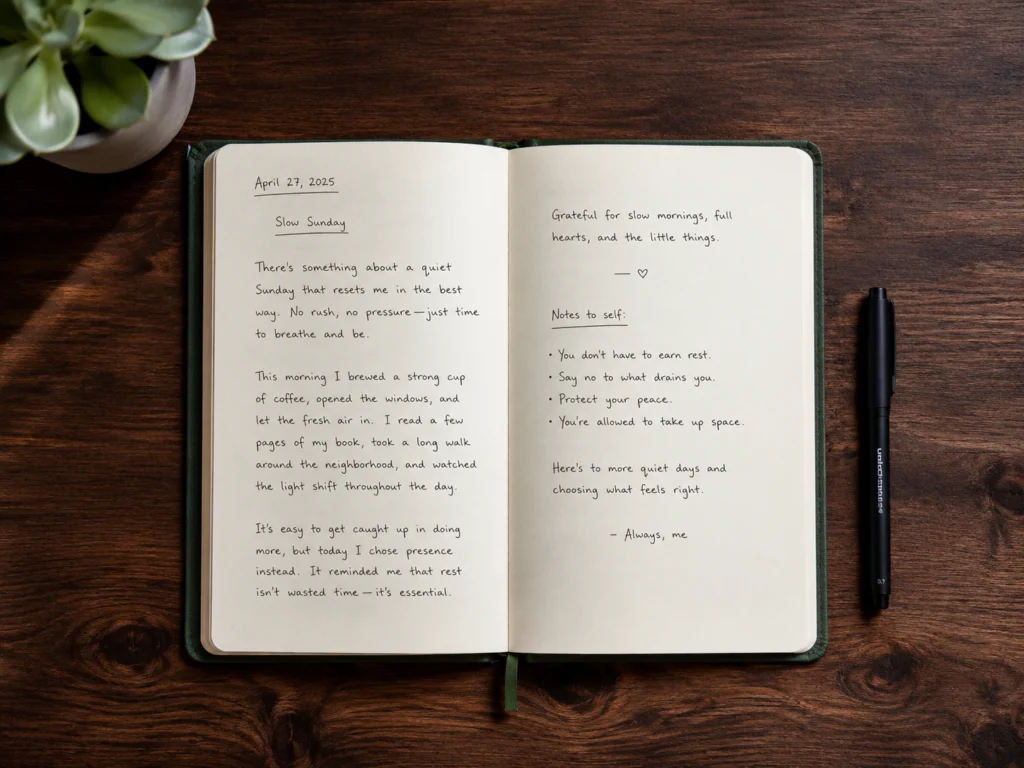
TL;DR: Journaling works best when you keep it simple. Pick a notebook you like, write for 5–10 minutes at the same time each day, and don’t judge what comes out. The research shows benefits show up well before you feel like you’ve “figured it out.” You don’t need the right pen, the right prompts, or a perfect morning routine. You just need to start.
Getting started with journaling sounds simple enough. You buy a nice notebook, sit down, and… nothing. The blank page sits there.
You write two sentences, decide they’re too boring, and close the cover.
Three weeks later the journal is under a pile of books and you’ve convinced yourself you’re just “not a journal person.”
That’s a setup problem, not a personality trait.
Most guides tell you journaling will change your life, then give you a 12-step morning ritual that requires waking up at 5 a.m. and a $40 pen.
This one skips all of that. What follows is the shortest, most practical path to a journaling habit that survives contact with a real, busy life.
- What Journaling Actually Is (and Isn’t)
- Why Bother? What the Research Actually Shows
- Step 1: Pick a Format Before You Pick a Notebook
- Step 2: Choose a Notebook (Without Overthinking It)
- Step 3: Set a Time and Keep It Consistent
- Step 4: Handle the Blank Page
- Step 5: Keep Going Past the Point Where It Feels Hard
- What to Write When You Have No Idea
- Do You Need Any Special Equipment?
- Paper vs. Digital: Does It Matter?
- How Long Before You Notice a Difference?
- A Note on Privacy
- FAQ
- The Short Version
- Keep Reading
What Journaling Actually Is (and Isn’t)
Journaling is writing down your thoughts, regularly, in a private space. That’s it. It’s not a diary where you document every event of your day.
It doesn’t have to be a gratitude list, morning pages, or anything that requires a routine you don’t have. It doesn’t need to be beautiful, coherent, or insightful.
The version that works for you is the one you’ll actually do. That might be three messy sentences before bed. It might be a weekly brain dump on Sunday. It might be a structured prompt-based journal with specific questions. All of these count.
The distinction worth making is between expressive journaling (writing about your inner life, thoughts, emotions, worries, goals) and record-keeping journaling (noting events, tasks, or plans).
Both have value, but the research on journaling’s mental health benefits applies mostly to the expressive kind.
Why Bother? What the Research Actually Shows
If you need a reason to start before you feel like it, here’s one: the evidence on journaling is stronger than most people expect.
Journaling is also one of the most accessible offline hobbies available. No equipment, no setup, no learning curve.
For a full list of screen-free activities worth picking up alongside it, see What Are Analog Hobbies? A Starter List for People Tired of Screens.
James Pennebaker, a social psychologist at the University of Texas at Austin, has been studying expressive writing since the mid-1980s.
In his landmark 1986 study, published in the Journal of Abnormal Psychology, participants who wrote about emotionally difficult experiences for 15 minutes over four consecutive days visited the campus health center at roughly half the rate of the control group over the following six months.
A 1988 follow-up by Pennebaker, Kiecolt-Glaser, and Glaser confirmed both the reduction in health center visits and measurable immune system changes.
Pennebaker’s 2018 review in Psychological Science summarizes four decades of subsequent research validating these findings.
The effect size is real but worth framing accurately. A meta-analysis of 13 expressive writing studies by Smyth (1998) found a significant medium effect (d = 0.47) across physical health, psychological wellbeing, physiological functioning, and general functioning.
A larger 2006 meta-analysis by Frattaroli covering 146 randomized studies confirmed the effect is consistent: meaningful in practice, but not a transformation of your life in two weeks.
A 2024 systematic review published in Healthcare (Singh et al.), analyzing over 2,600 participants across 20 studies, found that habits generally begin forming within about 59–66 days.
That number matters because it tells you how long to push through before journaling starts to feel natural.
None of this means journaling is a cure for anything serious. But for day-to-day stress, mental clarity, and self-awareness, it’s one of the lowest-cost, highest-return habits available.
Step 1: Pick a Format Before You Pick a Notebook
The biggest mistake beginners make is buying a beautiful notebook before deciding what they actually want to do with it.
Then the journal becomes too precious to write in, and it joins the graveyard of unused notebooks in the drawer.
Decide on your format first.
Free-form journaling is exactly what it sounds like: you write whatever is on your mind, stream-of-consciousness, no structure.
Good for processing emotions, working through decisions, and general mental clearing. If you don’t know where to start, start here.
Prompt-based journaling gives you a question to answer each day. A lot of beginners find it much easier than staring at a blank page.
Examples: What am I avoiding right now? What went well today and why? What’s taking up space in my head?
Gratitude journaling involves listing specific things you’re grateful for.
Studies on gratitude journaling, including a systematic review published in the Journal of Psychosomatic Research (Boggiss et al., 2020), show benefits for overall wellbeing and reduced stress.
The thing that actually makes it work: specificity. “I’m grateful for my coffee this morning” lands better than “I’m grateful for my life.”
Hybrid. Most consistent journalers do a combination. A few lines of free-form, then a prompt or two, then a quick note about tomorrow. Whatever keeps you coming back.
Once you know how you want to write, the next question is what to write in. This is where most beginners overcomplicate things.
Step 2: Choose a Notebook (Without Overthinking It)
You don’t need to spend a lot. You do need something you’re glad to pick up.
The two most-recommended journals for beginners in 2026 are the Leuchtturm1917 A5 Hardcover and the Moleskine Classic Notebook.

Here’s the honest comparison:
| Feature | Leuchtturm1917 A5 Hardcover | Moleskine Classic Large |
|---|---|---|
| Price (Amazon) | ~$25 | ~$20 |
| Paper weight | 80gsm | 70gsm |
| Numbered pages | Yes (251 pages) | No |
| Table of contents | Yes (blank, fill yourself) | No |
| Bookmarks | 2 ribbons | 1 ribbon |
| Back pocket | Yes (expandable) | Yes (expandable) |
| Ruling options | Dotted, ruled, squared, plain | Ruled, squared, plain |
| Pen bleed risk | Low (80gsm handles most gel pens) | Very low (thicker paper) |
| Best for | People who want to find entries later | People who want to just write |
Both are solid choices. Go with the Leuchtturm if you care about finding entries later; go with the Moleskine if you just want to write and move on.
At Mindfulova, we’ve tested both over several months of daily writing. The Leuchtturm wins for anyone who plans to keep journaling long-term.
The numbered pages sound like a small feature until you’re three months in and trying to find something you wrote in October.
The Moleskine is genuinely fine, and if you already own one or find it cheaper, use it. But if you’re buying fresh, the Leuchtturm is worth the extra few dollars.
For a side-by-side comparison of seven beginner journals across paper quality, price, and format (including options under $15), see Best Journals for Beginners in 2026: Tested and Ranked.
Our pick for beginners: The Leuchtturm1917 A5 Dotted is worth the extra few dollars for most people. The numbered pages and index help you actually find what you wrote, which matters more once you’re a few months in. Check current price on Amazon
If you want to spend less, a basic $8–$12 college-ruled notebook from any office supply store works fine. Don’t let the notebook be the reason you delay starting.
Having the right notebook helps, but it won’t build the habit by itself. That comes down to when you write, not what you write in.
Step 3: Set a Time and Keep It Consistent
The research on habit formation is clear: morning habits and self-chosen habits form faster than others.
The 2024 systematic review by Singh et al. in Healthcare found that habits practiced in the morning and chosen voluntarily tend to reach automaticity sooner, because there are fewer competing demands and the behavior is intrinsically motivated.
The timing question has more nuance than it looks, though. Morning and evening journaling produce meaningfully different outcomes depending on what you want from the practice. Morning Journaling vs. Evening Journaling: Which One Is Right for You? breaks down both with practical guidance on switching between them.
That said, the best time to journal is when you’ll actually do it. For some people that’s 7 a.m. before the day starts. For others it’s the last 10 minutes before bed.
Both work. What doesn’t work is “whenever I feel like it,” because that quickly becomes never.
Pick a time. Write it in your calendar like an appointment for the first two weeks. Anchor it to something you already do: right after morning coffee, right after brushing teeth at night. The anchor behavior gives the new habit something to attach to.
For the first week, five minutes is enough. Set a timer if you want. Write until it goes off, then stop. This removes the pressure of not knowing when to finish.
Step 4: Handle the Blank Page

The blank page is the #1 reason people quit in week one. Here are three ways to get past it:
Start with a state-of-mind sentence. One line: “Right now I’m feeling ___ because ___.” It doesn’t have to be interesting. It just breaks the seal, and usually something follows.
Use a prompt. Keep a short list of 5–6 prompts in the inside cover of your journal. When you’re stuck, pick one. Some starters that work well: What am I thinking about that I haven’t said out loud? What do I want more of this week? What’s something I did today that I’m glad I did?
Write about not knowing what to write. Seriously. “I’m sitting here and I have no idea what to write. I had an okay day, nothing eventful. I made pasta. I feel kind of tired but not in a bad way.” That’s a journal entry. It doesn’t need to solve anything.
The goal in the first month isn’t quality. It’s repetition.
Step 5: Keep Going Past the Point Where It Feels Hard
Most people quit journaling around weeks 3–5. The initial novelty is gone, and it hasn’t become automatic yet. This is normal and predictable.
The 2024 habit formation research shows the median time for a habit to become automatic is 59–66 days, with some people needing up to 335 days depending on the behavior and individual.
The plateau phase (roughly weeks 3–6) is where the neurological pattern is actually forming. Stopping there is stopping right before it clicks.
A few practical ways to stay consistent through this window:
Lower the bar aggressively. If you miss two days, your next entry doesn’t need to catch up. Write one sentence. That counts.
Avoid re-reading old entries during the first month. It’s tempting, but it usually triggers self-judgment and comparison. Just keep writing forward.
Change the format if you’re bored. Boredom with a format isn’t failure. Switch from free-form to prompts, or try a list-based entry for a week. The habit is what matters, not the structure.
What to Write When You Have No Idea
Ten prompts below are enough to get started. If you want a longer, categorized list organized by mood, goal, and situation (one you can keep coming back to), see 50 Journal Prompts for When You Have Nothing to Write About.
Here are 10 prompts to keep in your inside cover:
- What’s something I’ve been meaning to deal with but haven’t?
- What would make this week feel like a success?
- Who did I talk to today, and what did I take away from it?
- What’s something I’m grateful for that I haven’t acknowledged recently?
- What am I avoiding, and why?
- What do I need less of right now?
- What’s a decision I’m sitting on? What’s stopping me?
- What’s one thing I did today that I’m glad I did?
- How do I actually feel, versus how I said I was doing?
- What do I want to remember about this period of my life?
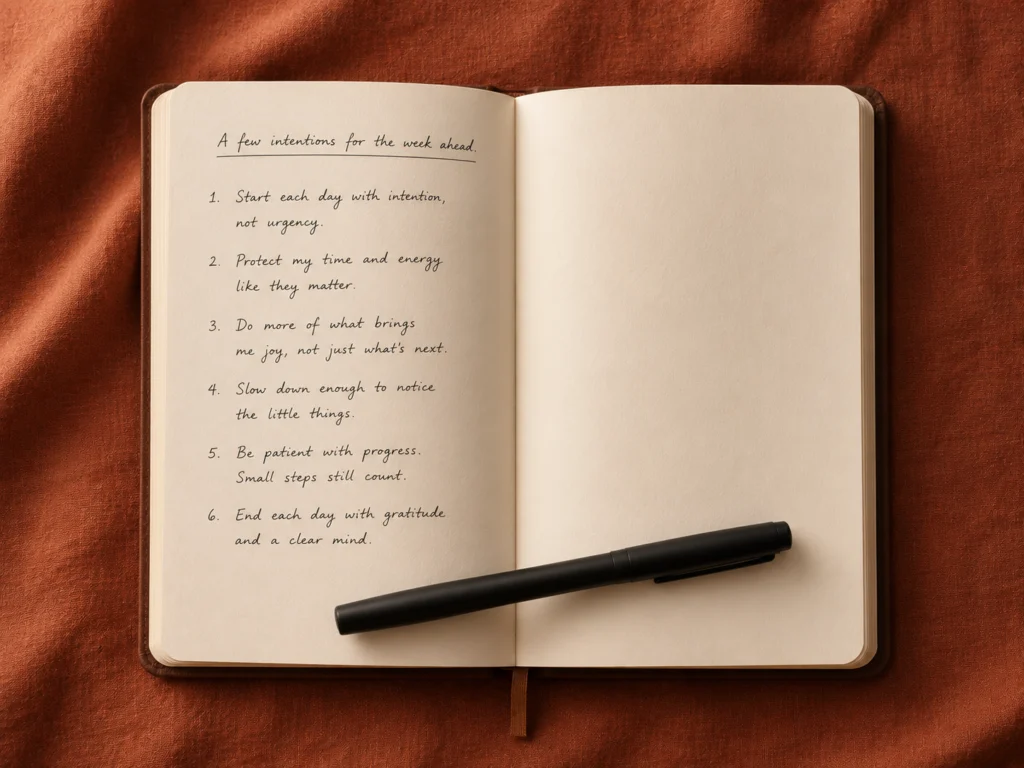
None of these require you to have an interesting day. They work on Tuesday evenings when nothing happened.
One more thing beginners often wonder about before they start: whether they need anything beyond a notebook and pen. The short answer is no.
Do You Need Any Special Equipment?
No. A pen and any notebook get the job done.
That said, the right pen matters more than people admit. Scratchy pens slow you down. Gel pens that bleed through thin paper are genuinely frustrating, especially once you’re mid-thought.
For most journals, a basic gel pen (Muji 0.5mm, Pilot G2, or Uni-ball Signo) writes smoothly without bleeding through standard 80gsm paper.
They cost $2–$5 each and make a real difference in how enjoyable the process feels. We use the Muji 0.5mm almost exclusively.
It doesn’t skip, dries fast enough that left-handers can use it without smearing, and costs less than a coffee.
The Pilot G2 writes a bit wetter, which some people prefer but can ghost on lighter paper. Either works. The Muji is just the one we keep coming back to.
Recommended pen for beginners: The Muji Gel Ink Ballpoint 0.5mm is $2–$3 per pen, writes cleanly on both Leuchtturm and Moleskine paper, and doesn’t smear. Find it on Amazon
You don’t need washi tape, stickers, calligraphy sets, or a special light. Those come later, if at all.
Paper vs. Digital: Does It Matter?
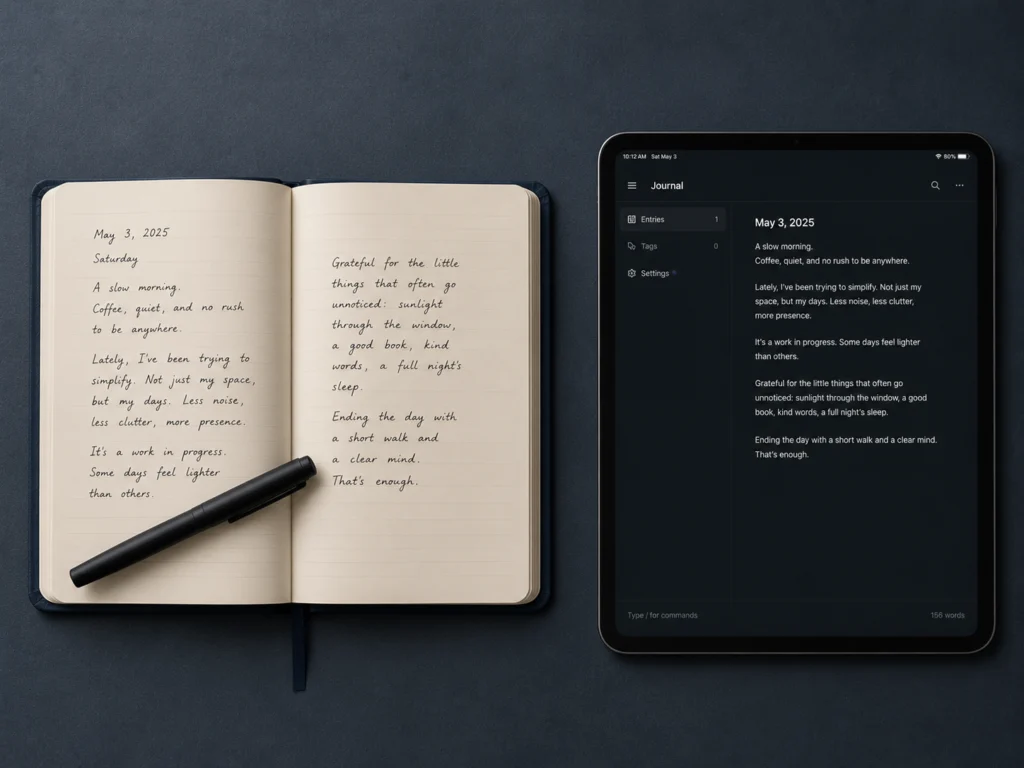
Both work. But they’re not the same experience.
Research in neuroimaging shows why. A 2023 EEG study by Van der Weel and Van der Meer at the Norwegian University of Science and Technology recorded brain activity in 36 university students and found that handwriting produced widespread connectivity across visual, sensory, and motor regions, patterns associated with memory formation and learning.
Typing produced minimal activity in the same areas. A separate 2014 study by Mueller and Oppenheimer found that note-takers who wrote by hand retained and understood information more deeply than those who typed, likely because the slower pace forced active processing rather than verbatim transcription.
That study focused on classroom note-taking, but the underlying mechanism applies directly to journaling: handwriting slows you down enough to actually think.
For journaling specifically, many people find that handwriting slows them down in a useful way, while typing can feel like sending an email to yourself. That’s not universal. If digital journaling is what you’ll actually do, do that.
If you go digital, Day One (iOS/macOS) and Journey (cross-platform) are the most-used dedicated journaling apps in 2026.
Both allow private entries, tagging, and photo attachments, and both have free tiers worth starting with.
If you go paper, the Leuchtturm or Moleskine recommendations above hold.
Whichever format you choose, the question most beginners actually care about is the same: how long until this starts to feel like it’s working?
If you want a structured start: The Five Minute Journal by Intelligent Change ($25–$30 on Amazon) has morning and evening prompt sections built in. It reduces the blank-page problem entirely and works well for people who prefer a container rather than open-ended writing. Check it on Amazon
How Long Before You Notice a Difference?
Honest answer: it varies.
Some people notice reduced anxiety and clearer thinking within 2–3 weeks of consistent writing.
Others don’t notice much until they read back through a month of entries and realize they’ve quietly been working through something the whole time.
The Pennebaker research suggests measurable physiological changes (fewer health clinic visits, improved immune markers) appeared within six months of regular expressive writing.
For subjective measures like mood and clarity, most studies show effects emerging within 4–8 weeks.
Don’t journal to feel results. Journal because you’re building a habit. The results tend to arrive without announcement.
A Note on Privacy
Write as if nobody will ever read it. That’s the whole point.
If you’re worried someone will, keep your journal somewhere private or use a digital app with a password.
Journaling about what you think other people want to hear, or self-censoring because you’re worried it might be found, defeats the purpose entirely. The therapeutic mechanism depends on honest expression.
If you want to use a physical journal, the Leuchtturm1917’s elastic closure and back pocket offer some physical protection, though neither is a lock.
FAQ
No. Daily journaling is the fastest way to build the habit, but consistency matters more than frequency. Three times a week, written consistently for months, beats daily writing that collapses after week two. The 2024 habit formation review found morning practices and self-selected habits form faster, but “faster” still means weeks, not days. Start with a realistic frequency and increase from there.
Morning and evening both have real advantages. Morning journaling sets a mental baseline before the day’s noise accumulates. Evening journaling helps process what happened and clear your head before sleep. The research leans slightly toward morning for habit formation speed, but the best time is the one you’ll stick to. For a detailed comparison of what each timing actually produces and how to decide, see Morning Journaling vs. Evening Journaling: Which One Is Right for You?
There’s no minimum. Five sentences is a legitimate entry. So is two paragraphs. Most consistent journalers write between 150–400 words per session, which takes roughly 5–15 minutes. If it starts to feel like a job, that’s a sign to shorten it. Sustainability beats thoroughness.
Skip the guilt and pick back up. Don’t try to catch up on what you missed, just write today’s entry. Missing days is part of building any habit. The research on habit formation shows that single missed days don’t significantly disrupt the process. It’s repeated, extended gaps that do.
Evidence suggests yes, with caveats. A 1998 meta-analysis by Smyth covering 13 expressive writing studies found significant improvements in psychological wellbeing across healthy participants. Multiple subsequent reviews have confirmed the effect, though the size is modest rather than dramatic. Journaling is not a substitute for professional support if you’re dealing with clinically significant anxiety or depression. It’s a tool, not a treatment.
No. Journaling about ordinary days, small observations, and mundane decisions is completely valid and still produces benefits. The Pennebaker research specifically studied expressive writing about difficult events, but broader journaling research shows value across a wide range of content. Write what’s on your mind. Some days that’s a problem you’re working through. Some days it’s what you had for dinner and why it annoyed you. Both count.
The Short Version
Start with five minutes. Use any notebook you like. Write at the same time each day, attached to something you already do.
Don’t judge what comes out. Push through weeks 3–5 when it feels like a chore, because that’s when the habit is forming. Lower the bar aggressively when life gets busy.
The rest, the right notebook, the perfect prompts, the ideal format, you’ll figure out as you go. The only version of journaling that doesn’t work is the one you never start.
If you’re looking for other offline habits to build alongside this one, see What Are Analog Hobbies? A Starter List for People Tired of Screens.
Keep Reading
- Best Journals for Beginners in 2026: Tested and Ranked
- 50 Journal Prompts for When You Have Nothing to Write About
- Morning Journaling vs. Evening Journaling: Which One Is Right for You?
- What Are Analog Hobbies? A Starter List for People Tired of Screens

We research screen-free habits, analog hobbies, and offline routines so you can spend less time scrolling and more time doing things that actually feel good. Every article on this site is based on primary research and verified sources, not recycled wellness advice.
Learn more on our About page.
Sources used in this article:
- Pennebaker, J.W. & Beall, S.K. (1986). Confronting a traumatic event: Toward an understanding of inhibition and disease. Journal of Abnormal Psychology, 95, 274–281.
- Pennebaker, J.W., Kiecolt-Glaser, J., & Glaser, R. (1988). Disclosure of traumas and immune function. Journal of Consulting and Clinical Psychology, 56, 239–245.
- Smyth, J.M. (1998). Written emotional expression: Effect sizes, outcome types, and moderating variables. Journal of Consulting and Clinical Psychology, 66(1), 174–184.
- Frattaroli, J. (2006). Experimental disclosure and its moderators: A meta-analysis. Psychological Bulletin, 132(6), 823–865.
- Singh, B., Murphy, A., Maher, C., & Smith, A.E. (2024). Time to Form a Habit: A Systematic Review and Meta-Analysis of Health Behaviour Habit Formation and Its Determinants. Healthcare, 12(23), 2488. https://doi.org/10.3390/healthcare12232488
- Boggiss, A.L. et al. (2020). A systematic review of gratitude interventions: Effects on physical health and health behaviors. Journal of Psychosomatic Research, 135, 110165.
- Mueller, P.A. & Oppenheimer, D.M. (2014). The pen is mightier than the keyboard. Psychological Science, 25(6), 1159–1168.
- Van der Weel, F.R. & Van der Meer, A.L.H. (2023). Handwriting but not typewriting leads to widespread brain connectivity: A high-density EEG study with implications for the classroom. Frontiers in Psychology, 14, 1219945.